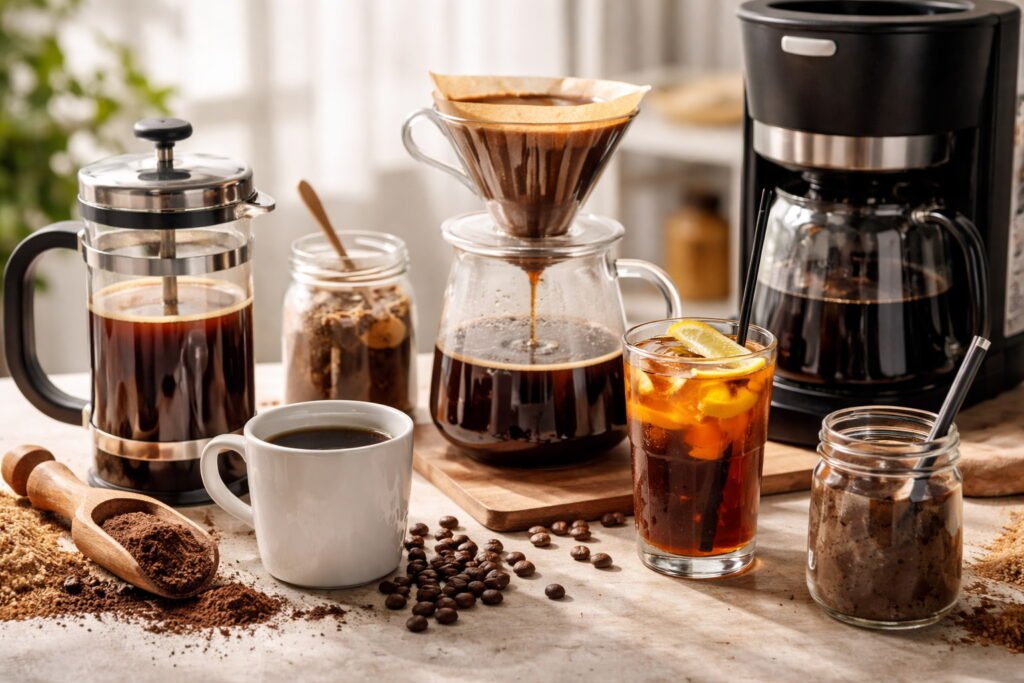
Brewing great coffee doesn’t require a barista certification or expensive gear. Learning how to brew coffee at home for beginners is surprisingly simple—and once you understand the basics, your daily cup can go from average to genuinely satisfying.
This guide breaks everything down into clear, practical steps. You’ll learn what actually matters (and what doesn’t), how to choose the right setup, and how to start brewing coffee that tastes balanced, smooth, and consistent—right from your kitchen.
In This Article
Why Brewing Coffee at Home Is Easier Than You Think
Coffee brewing often looks complicated from the outside—scales, kettles, fancy gear. In reality, great coffee comes down to a few simple principles, not complexity.
Most beginners overestimate what they need. You don’t need a full coffee bar setup to get started. A basic brewer, decent coffee, and a little attention to detail can already deliver excellent results.
Here’s why brewing at home is worth it:
- Save money long-term compared to daily café visits
- Control your flavor (stronger, smoother, less bitter)
- Customize your routine to match your taste and schedule
What matters most isn’t equipment—it’s understanding how brewing works. Once you grasp that, everything else becomes easier.
The Basics of Coffee Brewing Every Beginner Should Know
Before jumping into tools or methods, it helps to understand what’s actually happening when you brew coffee.
What Brewing Really Means (Without the Jargon)
Brewing coffee is simply extracting flavors from ground coffee using water. Water pulls out oils, acids, and soluble compounds that create taste.
Too much extraction → bitter coffee
Too little extraction → sour or weak coffee
The goal is balance.
The 3 Pillars of Great Coffee
Every good cup is built on three key elements:
- Coffee → Quality, freshness, and grind size
- Water → Temperature and cleanliness
- Time → How long the water interacts with the coffee
Change one of these, and the flavor changes immediately.
Why Small Adjustments Make a Big Difference
Many beginners think bad coffee means bad beans. In reality, it’s often small issues like:
- Water too hot or too cool
- Grind size not matched to the method
- Incorrect coffee-to-water ratio
A tiny tweak can completely transform your cup. That’s what makes home brewing both simple and rewarding.
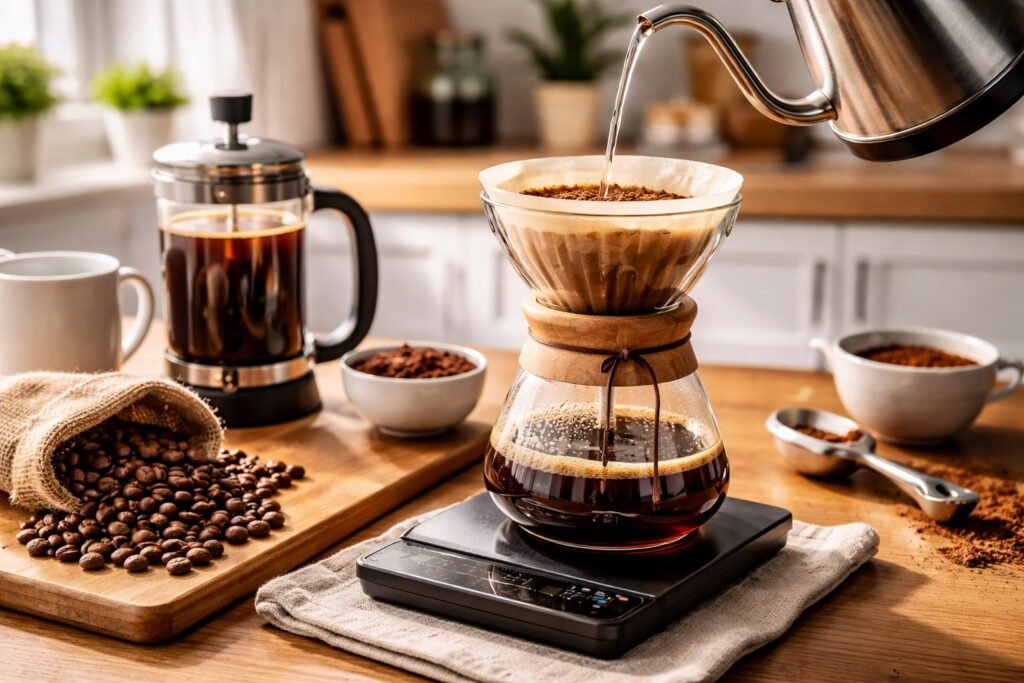
Essential Equipment for Brewing Coffee at Home (Beginner-Friendly Setup)
Starting with the right tools makes learning how to brew coffee at home for beginners much smoother—but it doesn’t have to be expensive.
Must-Have vs Nice-to-Have Gear
Start with the essentials:
- A brewing device
- Ground coffee or whole beans
- Hot water
- A basic measuring method (spoon or scale)
Upgrade later with:
- Burr grinder (for better consistency)
- Gooseneck kettle (for control in pour-over)
- Digital scale (for precision)
Beginner-Friendly Brewing Methods
Each method offers a slightly different experience. Here’s a quick breakdown:
| Method | Difficulty | Flavor Profile | Why It’s Good for Beginners |
| French Press | Easy | Full-bodied, rich | Forgiving and simple |
| Pour-Over | Medium | Clean, bright | Great for learning control |
| Drip Coffee Maker | Very easy | Balanced | Convenient and consistent |
Grinder: Blade vs Burr (Simple Explanation)
Grinding your own coffee can instantly improve flavor.
- Blade grinder → Cheap, but uneven grind
- Burr grinder → More consistent, better taste
Budget vs Quality: Where to Spend First
You don’t need premium gear to start. Focus on this order:
- Fresh coffee beans
- A reliable brewing method
- Grinder upgrade (when ready)
A simple setup used correctly will always outperform expensive gear used poorly.
Choosing the Right Coffee Beans for Your First Brew
Great coffee starts before the brewing even begins. If your beans aren’t right, no technique can fully fix the result. The good news? Choosing beginner-friendly coffee is simple once you know what to look for.
Whole Beans vs Pre-Ground Coffee
- Whole beans → Fresher, more flavorful, longer shelf life
- Pre-ground coffee → Convenient, but loses aroma quickly
Best approach for beginners:
Start with pre-ground if needed, but switch to whole beans when you can. The flavor improvement is immediate.
Understanding Roast Levels (Without Overthinking It)
Roast level affects how your coffee tastes more than most beginners expect:
- Light roast → Bright, acidic, sometimes fruity
- Medium roast → Balanced, smooth, slightly sweet
- Dark roast → Bold, bitter, smoky
Beginner tip:
Start with a medium roast. It’s the easiest to enjoy and forgiving across different brewing methods.
Freshness: The Hidden Key to Better Coffee
Coffee is best when it’s fresh—not just “not expired.”
Look for:
- A roast date (not just expiration date)
- Beans used within 2–4 weeks after roasting
Avoid:
- Coffee that’s been sitting open for too long
- Bulk bins with unknown freshness
Fresh coffee = more aroma, more flavor, less bitterness.
Beginner-Friendly Flavor Profiles
If you’re not sure what you like yet, start simple:
- Chocolatey & nutty → Smooth and low acidity (great daily drinkers)
- Caramel & sweet → Balanced and easy to enjoy
- Fruity & floral → More complex, better for later exploration
Finding your preference takes time, but starting with approachable flavors builds confidence.
Grind Size Made Simple (And Why It Matters More Than You Think)
Grind size is one of the most overlooked factors in how to brew coffee at home for beginners—but it directly affects taste.
Why Grind Size Changes Everything
Water flows differently through coarse vs fine coffee grounds:
- Too fine → water extracts too much → bitter taste
- Too coarse → water passes too quickly → weak or sour taste
Balance comes from matching grind size to your brewing method.
Quick Grind Size Guide (Easy Visual Reference)
- Coarse (like sea salt) → French press
- Medium (like sand) → Drip coffee maker
- Fine (like sugar) → Espresso
Matching Grind Size to Brewing Method
| Brewing Method | Recommended Grind Size |
| French Press | Coarse |
| Pour-Over | Medium |
| Drip Machine | Medium |
| Espresso | Fine |
Using the wrong grind size is one of the fastest ways to ruin an otherwise good coffee.
Common Beginner Mistakes with Grinding
- Using one grind size for all methods
- Grinding too far in advance (loses freshness)
- Assuming finer always means stronger (it doesn’t)
Simple rule: Adjust grind size before changing anything else when your coffee tastes off.
How to Brew Coffee at Home Using the Simplest Methods
This is where everything comes together. These beginner-friendly methods show exactly how to brew coffee at home step by step, without confusion.
How to Brew Coffee at Home with a French Press
Best for: Rich, full-bodied coffee with minimal effort
What you need:
- French press
- Coarse coffee grounds
- Hot water (just off boil)
Steps:
- Add coffee (about 1:15 ratio, e.g., 20g coffee to 300ml water)
- Pour a small amount of water to wet the grounds (bloom for 30 seconds)
- Add remaining water and stir gently
- Let it steep for 4 minutes
- Press the plunger slowly and pour
What to expect:
A heavier, fuller cup with more body and natural oils.
How to Brew Coffee at Home with a Pour-Over
Best for: Clean, bright, and flavorful coffee
What you need:
- Pour-over dripper + filter
- Medium grind coffee
- Kettle (preferably gooseneck)
Steps:
- Rinse the paper filter with hot water
- Add coffee (about 1:16 ratio)
- Pour a small amount of water and let it bloom (30–45 seconds)
- Slowly pour water in circular motions
- Total brew time: 2.5–3 minutes
What to expect:
A lighter, cleaner cup that highlights subtle flavors.
How to Brew Coffee at Home with a Drip Coffee Maker
Best for: Convenience and consistency
What you need:
- Drip coffee machine
- Medium grind coffee
- Filter
Steps:
- Add coffee using a 1:15–1:17 ratio
- Fill the water reservoir
- Start the machine and let it brew
Easy upgrade tips:
- Use fresh coffee instead of pre-ground
- Clean your machine regularly
- Don’t leave coffee sitting on the hot plate too long
What to expect:
Balanced, smooth coffee with minimal effort.
Coffee-to-Water Ratio: The Secret to Consistent Results
If your coffee sometimes tastes great and other times disappointing, the issue is often inconsistency. Getting your coffee-to-water ratio right is the easiest way to fix that.
A Simple Ratio That Always Works
A good starting point for beginners:
- 1:15 ratio → stronger, richer coffee
- 1:16–1:17 ratio → more balanced, smoother taste
Example:
- 20g coffee → 300–340ml water
Quick Daily Cheat Sheet
| Coffee (grams) | Water (ml) | Strength |
| 15g | 225ml | Strong |
| 20g | 300ml | Balanced |
| 25g | 375ml | Smooth |
No scale? Use this simple guideline:
- 1 tablespoon coffee ≈ 5–7g
How to Adjust Based on Taste
- Too bitter? → Use more water or coarser grind
- Too weak? → Use more coffee or finer grind
Important: Change one variable at a time so you know what actually improves your brew.
Common Mistakes Beginners Make (And How to Fix Them Fast)
Even with good beans and equipment, a few small mistakes can ruin your coffee. The good news? These are easy to fix once you know what to watch for.
Using Stale Coffee
Coffee loses flavor quickly after grinding.
Fix:
- Buy smaller amounts
- Store in an airtight container
- Grind fresh when possible
Incorrect Water Temperature
Water that’s too hot or too cold affects extraction.
- Too hot → bitter taste
- Too cool → sour, under-extracted coffee
Ideal range: 90–96°C (just off boiling)
Over-Extraction vs Under-Extraction
This is where many beginners get stuck.
- Over-extraction → bitter, harsh finish
- Under-extraction → sour, thin, weak
Quick fixes:
- Bitter? → Coarser grind or shorter brew time
- Sour? → Finer grind or longer brew time
Eyeballing Instead of Measuring
Guessing leads to inconsistent results.
Fix:
- Use a simple scale or measuring spoon
- Stick to a repeatable ratio
Consistency builds better coffee habits faster than anything else.
How to Make Your Coffee Taste Better Without Expensive Gear
Better coffee doesn’t always come from better equipment. Small, intentional changes often make the biggest difference.
Use Better Water (Most People Ignore This)
Coffee is over 95% water. If your water tastes off, your coffee will too.
Tips:
- Use filtered water if possible
- Avoid distilled water (too flat)
Pre-Wetting (Blooming) Makes a Real Difference
Fresh coffee releases gas when hot water hits it. Blooming allows proper extraction.
How to do it:
- Pour a small amount of water
- Wait 30–45 seconds before continuing
Result: smoother, more even flavor
Store Your Coffee the Right Way
Bad storage kills good beans.
- Keep coffee in an airtight container
- Store in a cool, dark place
- Avoid the fridge (moisture issues)
Small Tweaks That Improve Every Cup
- Rinse paper filters before brewing
- Stir gently for even extraction
- Clean your equipment regularly
Exploring Flavor: How to Find Your Perfect Cup
Once you’ve nailed the basics of how to brew coffee at home for beginners, the next step is discovering what you actually enjoy. Coffee isn’t just strong or weak—it has layers of flavor that change depending on how you brew it.
Understanding the Core Flavor Elements
Every cup of coffee balances three main characteristics:
- Bitterness → Often from darker roasts or over-extraction
- Acidity → Bright, tangy notes (common in lighter roasts)
- Body → The weight or texture (light like tea vs heavy like cream)
A balanced cup doesn’t eliminate these—it harmonizes them.
How Brewing Method Changes Flavor
Different methods highlight different qualities:
- French Press → Fuller body, richer mouthfeel
- Pour-Over → Cleaner, brighter, more nuanced
- Drip Machine → Balanced and consistent
Trying the same beans across methods is one of the fastest ways to understand flavor differences.
How to “Dial In” Your Taste
Instead of guessing, make small adjustments:
- Change grind size slightly
- Adjust coffee-to-water ratio
- Experiment with brew time
Keep notes if possible. Over time, you’ll notice patterns—what you like and what to avoid.
Tip: If a coffee tastes “off,” it usually needs a small tweak, not a complete overhaul.
Beginner Brewing Tips That Instantly Upgrade Your Coffee
Improving your coffee doesn’t require complicated techniques. A few smart habits can make a noticeable difference right away.
Focus on Consistency First
Repeating the same method helps you understand what works.
- Use the same ratio daily
- Stick to one brewing method at a time
- Adjust only one variable when experimenting
Start Simple, Then Expand
Trying everything at once leads to confusion.
- Begin with one method (like French press or drip)
- Learn how it behaves
- Then explore pour-over or other styles
Build a Simple Coffee Routine
Consistency creates better results:
- Measure your coffee and water
- Use fresh beans
- Clean your equipment regularly
A simple routine beats a complicated setup every time.
FAQ: How to Brew Coffee at Home for Beginners
What is the easiest way to brew coffee at home?
The easiest method is a drip coffee maker or French press. Both require minimal technique and produce consistent results.
Do I really need a grinder as a beginner?
Not immediately. Pre-ground coffee works fine at first, but a burr grinder significantly improves flavor once you’re ready to upgrade.
How much coffee should I use per cup?
A good starting point is a 1:15 to 1:17 ratio. That’s about 15–20 grams of coffee per 250–300 ml of water.
Why does my coffee taste bitter or weak?
Bitter coffee usually means over-extraction (too fine or too long). Weak coffee often means under-extraction (too coarse or too short). Adjust grind size or ratio first.
Can I use tap water for brewing coffee?
Yes, but only if it tastes clean. If your tap water has a strong taste or odor, use filtered water for better results.
What grind size should I use for different brewing methods?
Use coarse for French press, medium for drip and pour-over, and fine for espresso. Matching grind size to method is essential for balanced flavor.
Start Brewing Better Coffee Today
Learning how to brew coffee at home for beginners isn’t about perfection—it’s about progress. Every small improvement adds up to a better cup.
Start with one method, use fresh coffee, and stick to a simple ratio. From there, tweak and experiment until you find what tastes right to you.
For deeper standards and best practices, you can explore guidelines from the Specialty Coffee Association, a trusted authority in coffee brewing.
Your next great cup doesn’t require more gear—just a little intention. Try one method from this guide today, adjust one variable, and enjoy the process of making coffee that’s truly yours.