
Great coffee doesn’t require a café visit—it starts in your kitchen. Home coffee brewing for beginners is all about learning a few simple principles that transform average coffee into something rich, balanced, and enjoyable every day.
This guide breaks everything down into clear, practical steps. You’ll learn the core fundamentals, how to avoid common mistakes, and how to start brewing coffee that actually tastes the way it should—smooth, flavorful, and consistent.
In This Article
Why Home Coffee Brewing Is Worth Learning (Even If You’re a Total Beginner)
Brewing coffee at home might seem intimidating at first, but it quickly becomes one of the most rewarding daily habits you can build.
You Save More Than Just Money
Daily café runs add up fast. Brewing at home costs significantly less per cup, especially when using quality beans. Over time, that difference becomes substantial without sacrificing taste.
You Control the Flavor
A barista can’t tailor every cup to your exact preference—but you can.
Strength, bitterness, acidity, and body are all adjustable once you understand the basics.
You Build a Skill That Improves Daily Life
Coffee isn’t just a drink—it’s a ritual. Learning how to brew properly turns a routine into something intentional and enjoyable.
What Most Beginners Get Wrong
Many beginners assume better coffee comes from expensive gear. In reality, poor technique ruins good beans faster than cheap equipment ever will.
Common early mistakes:
- Using the wrong grind size
- Guessing measurements instead of using ratios
- Brewing with water that’s too hot or too cold
Fixing these alone can dramatically improve your coffee overnight.
What “Home Coffee Brewing for Beginners” Really Means
Before buying equipment or trying recipes, it helps to understand what you’re actually learning.
It’s Not Just About Making Coffee
There’s a big difference between:
- Instant coffee – quick but limited in flavor
- Basic brewing – simple methods with inconsistent results
- Specialty-style brewing – controlled, repeatable, and flavorful
This guide focuses on helping you move into that third category—without making things complicated.
The Real Goal: Consistency Over Complexity
Beginners often chase perfection too early. A better approach is simpler:
Brew the same good cup every day before trying to brew the perfect cup.
Consistency builds confidence, and confidence leads to better experimentation later.
What You’ll Learn in This Guide
You don’t need to master every brewing method. Instead, you’ll focus on:
- Understanding how coffee extraction works
- Learning one reliable brewing method
- Making small adjustments to improve taste
That’s enough to produce café-quality coffee at home.
The 4 Fundamentals of Great Home Coffee Brewing
Every great cup of coffee comes down to four core variables. Master these, and everything else becomes easier.
Coffee-to-Water Ratio (Your Flavor Foundation)
This is the backbone of home coffee brewing.
A good starting point:
- 1:15 to 1:18 ratio (1 gram of coffee to 15–18 grams of water)
Example:
- 20g coffee → 300–360ml water
Stronger coffee = lower ratio (1:15)
Lighter coffee = higher ratio (1:18)
Using a digital scale removes guesswork and ensures consistency.
Grind Size Explained Simply
Grind size controls how fast water extracts flavor.
- Coarse → French press (slow extraction)
- Medium → Drip coffee maker
- Fine → Espresso (fast extraction)
If your coffee tastes:
- Bitter → grind is likely too fine
- Sour → grind is likely too coarse
Small adjustments here make a huge difference.
Water Quality and Temperature Matter More Than You Think
Coffee is over 98% water, so quality matters.
- Use filtered water if possible
- Ideal brewing temperature: 90–96°C (195–205°F)
Water that’s too hot extracts harsh bitterness. Too cool, and the coffee tastes flat or sour.
Brew Time: The Hidden Variable
Each brewing method has an ideal contact time between water and coffee.
General guidelines:
- French press: 4 minutes
- Pour-over: 2–3 minutes
- AeroPress: 1–2 minutes
If brew time is too long → over-extraction (bitter)
If too short → under-extraction (sour)
Essential Equipment for Home Coffee Brewing (Beginner-Friendly Setup)
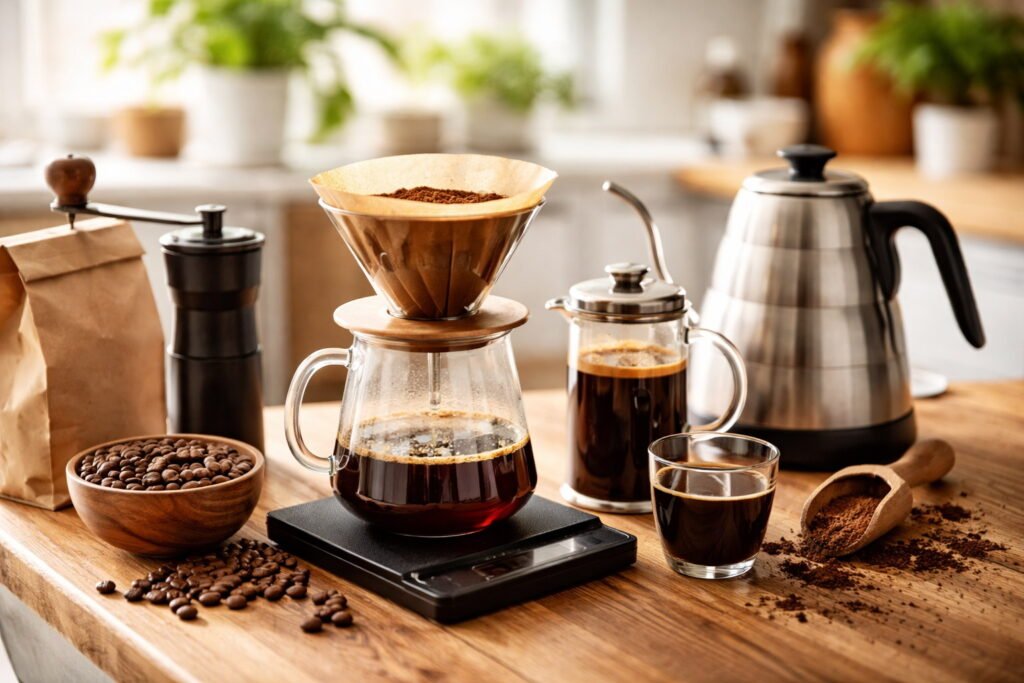
Getting started with home coffee brewing for beginners doesn’t require a full barista setup. Focus on a few key tools that directly impact flavor and consistency.
Must-Have Tools (Start Here First)
These are non-negotiable if you want reliable results:
- Coffee grinder (preferably burr grinder)
- Digital scale (for accurate ratios)
- Kettle (any kettle works, gooseneck is a bonus)
- Brewing device (choose one method to start)
Why this matters: Measuring and grinding fresh coffee instantly improves taste more than upgrading machines.
Nice-to-Have Upgrades (Add Later)
Once you’re comfortable, these can refine your process:
- Gooseneck kettle for better pouring control
- Thermometer (if your kettle doesn’t show temperature)
- Timer (often built into your phone or scale)
Blade vs Burr Grinder (Critical Difference)
| Feature | Blade Grinder | Burr Grinder |
| Grind consistency | Uneven | Uniform |
| Flavor quality | Inconsistent | Balanced |
| Control | Limited | Precise |
Bottom line:
A burr grinder is one of the best upgrades you can make early on. It ensures even extraction, which leads to better-tasting coffee.
Do You Really Need a Scale?
Yes—if you care about consistency.
Eyeballing coffee works occasionally, but small differences in measurement can completely change flavor. A scale keeps your brew repeatable.
Pro tip: Consistency is what separates random good cups from reliably great ones.
Budget vs Beginner-Plus Setup
Simple starter setup:
- Manual burr grinder
- Basic kettle
- French press or drip brewer
- Entry-level scale
Upgraded beginner setup:
- Electric burr grinder
- Gooseneck kettle
- Pour-over dripper or AeroPress
- Precision scale with timer
You don’t need everything at once. Start simple, then upgrade based on what you enjoy brewing.
Choosing the Right Coffee Beans for Beginners
Even with perfect technique, bad beans lead to disappointing coffee. Choosing the right beans is a foundational step in home coffee brewing for beginners.
Arabica vs Robusta (Keep It Simple)
- Arabica → smoother, more complex flavors, slightly acidic
- Robusta → stronger, more bitter, higher caffeine
For most beginners, Arabica is the better starting point because it’s easier to enjoy and more forgiving.
Whole Beans vs Pre-Ground Coffee
- Whole beans → fresher, more aromatic, better flavor
- Pre-ground → convenient but loses flavor quickly
If possible, always choose whole beans and grind just before brewing.
Understanding Roast Levels (And What They Taste Like)
| Roast Level | Flavor Profile | Best For |
| Light roast | Bright, acidic, fruity | Pour-over, AeroPress |
| Medium roast | Balanced, slightly sweet | Most brewing methods |
| Dark roast | Bold, bitter, smoky | French press, milk drinks |
Beginner tip:
Start with a medium roast. It offers balance without extreme acidity or bitterness.
Freshness Makes a Bigger Difference Than You Think
Coffee is at its best within:
- 7–21 days after roasting
Look for:
- Roast date (not expiration date)
- Airtight packaging
Avoid storing beans in the fridge. Instead:
- Keep them in an airtight container
- Store in a cool, dark place
Popular Home Coffee Brewing Methods Explained
Choosing the right method can feel overwhelming. The goal isn’t to try everything—it’s to pick one method that fits your taste and lifestyle.
Pour-Over (Clean and Flavorful)
A favorite for clarity and control.
What to expect:
- Bright, clean cup
- Highlights subtle flavor notes
Best for:
People who enjoy experimenting and dialing in their brew.
French Press (Rich and Full-Bodied)
One of the simplest and most forgiving methods.
What to expect:
- Heavy body
- Strong, bold flavor
Best for:
Beginners who want an easy, consistent brew without too much technique.
AeroPress (Fast and Versatile)
Compact, flexible, and surprisingly powerful.
What to expect:
- Smooth, balanced coffee
- Can mimic espresso-style or filter coffee
Best for:
Those who want speed and versatility in one device.
Drip Coffee Maker (Convenient and Consistent)
A common household option that requires minimal effort.
What to expect:
- Mild, smooth coffee
- Consistent results with little involvement
Best for:
Busy mornings and brewing multiple cups at once.
Which Brewing Method Should You Start With?
If you’re unsure, here’s a quick guide:
- Easiest: French press
- Most balanced: AeroPress
- Best flavor clarity: Pour-over
- Most convenient: Drip machine
Smart approach: Pick one method, learn it well, and build from there.
Step-by-Step: Your First Home Coffee Brewing Routine
Starting your first brew can feel like a lot—but once you follow a simple routine, it becomes second nature. This section turns home coffee brewing for beginners into a repeatable process you can rely on every day.
A Simple, Beginner-Friendly Brewing Recipe
This method works well for pour-over, AeroPress, or even adapting to other brewers.
What you’ll need:
- Fresh coffee beans
- Burr grinder
- Scale
- Kettle (hot water around 90–96°C)
- Your chosen brewer
Step-by-step:
- Weigh your coffee → Start with 20g coffee
- Grind your beans → Medium grind (like sea salt)
- Heat your water → Around 300–340ml
- Bloom the coffee → Pour a small amount of water (40–50ml), wait 30–45 seconds
- Continue pouring → Slowly add the remaining water in stages
- Let it brew → Total time: ~2–3 minutes
- Serve and taste
How to Know If Your Coffee Is “Right”
A well-brewed cup should taste:
- Balanced (not too bitter or sour)
- Smooth (no harsh aftertaste)
- Clear in flavor (you can distinguish notes, even subtly)
Common Mistakes During Brewing
Avoid these early pitfalls:
- Pouring water too fast → uneven extraction
- Skipping the bloom → flat flavor
- Not measuring → inconsistent results
- Using the wrong grind size
Quick fix mindset: If it tastes off, adjust one variable at a time—not everything at once.
Home Coffee Brewing Tips to Instantly Improve Flavor
Once your routine is set, small tweaks can elevate your coffee dramatically. These tips are where beginners start tasting real improvement.
Adjust Grind Size Before Anything Else
Grind size is the fastest way to fix bad coffee.
- Too bitter? Try a slightly coarser grind
- Too sour? Try a slightly finer grind
Even tiny changes can shift the entire flavor profile.
Dial In Your Brew Like a Pro
Think of brewing as a balance:
- Extraction too high → bitter, dry finish
- Extraction too low → sour, weak taste
To fix:
- Adjust grind size
- Fine-tune brew time
- Slightly tweak your ratio
Use Better Water (It Matters More Than Beans Sometimes)
If your tap water tastes off, your coffee will too.
- Use filtered water whenever possible
- Avoid distilled water (it lacks minerals for extraction)
Keep Your Equipment Clean
Old coffee oils build up quickly and create unpleasant flavors.
- Rinse after every use
- Deep clean weekly
Clean gear = cleaner taste.
Small Changes That Make a Big Difference
- Preheat your brewer and cup
- Use fresh beans (within 2–3 weeks of roasting)
- Pour slowly and evenly
Great coffee isn’t about big upgrades—it’s about small, consistent improvements.
Understanding Coffee Flavor Without Overcomplicating It
Tasting coffee doesn’t require a trained palate. You just need to know what to look for.
The 3 Core Flavor Elements
Focus on these instead of overthinking tasting notes:
- Acidity → Brightness or liveliness (not sourness)
- Body → How heavy or light the coffee feels in your mouth
- Aftertaste → The flavor that lingers after swallowing
How Brewing Method Affects Flavor
Different brewing styles highlight different characteristics:
- Pour-over → clean, bright, more acidic
- French press → heavy, rich, full-bodied
- AeroPress → balanced, smooth
This is why the same beans can taste completely different depending on how you brew them.
How Beginners Can Start Noticing Flavor
You don’t need to identify “chocolate notes” or “citrus hints” right away.
Start simple:
- Does it taste strong or weak?
- Is it smooth or harsh?
- Do you prefer it bright or bold?
Over time, your palate naturally improves.
A Simple Way to Train Your Taste
Try brewing the same coffee with small changes:
- Slightly different grind size
- Slightly different ratio
Compare side by side.
This is the fastest way to understand how brewing affects flavor.
Common Home Coffee Brewing Mistakes Beginners Make
Even with good beans and decent equipment, a few small mistakes can ruin your cup. Catching these early will fast-track your progress in home coffee brewing for beginners.
Using Stale Coffee Beans
Coffee loses flavor quickly after roasting.
- Avoid beans with no roast date
- Use within 2–3 weeks after opening
- Store in an airtight container
Stale beans = flat, lifeless coffee.
Incorrect Water Temperature
Water that’s too hot or too cool throws off extraction.
- Too hot → bitter, harsh taste
- Too cool → weak, sour cup
Stick to 90–96°C (195–205°F) for best results.
Wrong Grind Size for the Method
Mismatch between grind size and brewing method leads to poor extraction.
- Fine grind in French press → muddy and bitter
- Coarse grind in pour-over → thin and sour
Always match grind size to your brewer.
Guessing Instead of Measuring
Eyeballing coffee might work once, but it won’t be consistent.
- Use a scale for coffee and water
- Stick to a repeatable ratio
Consistency is what turns “good sometimes” into “great every time.”
Budget vs Premium: Does Better Equipment Really Matter?
It’s easy to assume expensive gear equals better coffee. The truth is more nuanced.
What Actually Improves Taste
These upgrades have the biggest impact:
- Burr grinder → more even extraction
- Fresh beans → better flavor clarity
- Accurate scale → consistent results
What Doesn’t Matter as Much (At First)
- High-end espresso machines
- Fancy brewing gadgets
- Premium kettles with advanced features
Technique matters more than price.
A Smart Upgrade Path for Beginners
Instead of overspending early, follow this progression:
- Start with a basic setup
- Upgrade to a burr grinder
- Improve your beans
- Experiment with another brewing method
Focus on skill first, gear second.
Building Your Daily Home Coffee Routine
Consistency is where everything clicks. A simple routine removes guesswork and improves your results over time.
Create a Repeatable Process
Keep your workflow the same every day:
- Measure coffee and water
- Use the same grind setting
- Follow the same brew time
This makes it easier to identify what’s working—and what isn’t.
Time-Saving Brewing Habits
Busy mornings don’t have to mean bad coffee.
- Pre-measure beans the night before
- Use a method that fits your schedule (French press or drip for convenience)
- Heat water while grinding to save time
Stay Consistent, Then Improve
Avoid changing everything at once.
- Adjust one variable at a time
- Taste, evaluate, and refine
Small, controlled changes lead to big improvements.
Easy Coffee Recipes to Try at Home
Once you’re comfortable with the basics, experimenting with simple recipes keeps things fun and rewarding.
Iced Coffee (Clean and Refreshing)
How to make:
- Brew coffee slightly stronger than usual
- Pour over ice
- Optional: add milk or sweetener
Tip: Use large ice cubes to avoid watering it down too quickly.
Simple Milk-Based Coffee (No Espresso Machine Needed)
What to do:
- Brew strong coffee (lower water ratio)
- Heat and froth milk (even shaking in a jar works)
- Combine for a smooth, café-style drink
Flavor Variations to Try
Add subtle twists without overpowering the coffee:
- Vanilla extract
- Caramel syrup
- Cinnamon or cocoa powder
Keep it balanced—coffee flavor should still come through.
FAQ: Home Coffee Brewing for Beginners
How much coffee should I use per cup?
Start with a 1:15 to 1:18 ratio (e.g., 20g coffee to 300–360ml water). Adjust based on your taste preference.
Do I really need a grinder for home coffee brewing?
Yes, if you want better flavor. Freshly ground beans retain aroma and produce more balanced extraction.
What’s the easiest brewing method for beginners?
French press is the most forgiving. It requires minimal technique and delivers consistent results.
How do I store coffee beans properly?
Keep them in an airtight container, away from light, heat, and moisture. Avoid the fridge.
Why does my coffee taste bitter or sour?
Bitter usually means over-extraction (too fine grind or long brew time). Sour indicates under-extraction (too coarse or short brew time).
What grind size should I use for different methods?
Coarse for French press, medium for drip, and finer for espresso-style brewing.
Learn More About Coffee Standards and Brewing
If you want to go deeper into brewing science and professional standards, explore resources from the
Specialty Coffee Association (SCA):
👉 https://sca.coffee
This organization sets globally recognized guidelines for coffee quality, brewing, and education.
Start Brewing Better Coffee Today
You don’t need expensive gear or barista-level skills to make great coffee at home. What matters is understanding the basics and applying them consistently.
Start simple:
- Pick one brewing method
- Use fresh beans
- Follow a reliable ratio
Then experiment, adjust, and refine your process.
Your next great cup of coffee isn’t in a café—it’s waiting in your kitchen.

Meet Suzee Amelia, the creative voice behind this space—a blog dedicated to exploring coffee culture, lifestyle insights, and everyday inspiration. With a passion for discovering rich flavors and sharing practical tips, Sophie Langford brings a thoughtful and engaging approach to every post.
