

Making strong coffee at home without an espresso machine is easier than most people think—and often more flavorful. You don’t need expensive equipment to get a bold, rich cup that hits hard in both taste and caffeine.
This guide will show you exactly how to do it. You’ll learn what actually makes coffee strong, how to choose the right beans, and how to adjust your brewing to get intense, satisfying results every time.
In This Article
Why Strong Coffee Doesn’t Require an Espresso Machine
Many people assume that espresso equals strong coffee. That’s only partially true.
Espresso is concentrated, but strong coffee can be achieved using multiple brewing methods—often with more control over flavor and intensity.
Espresso vs Strong Coffee: What’s the Difference?
- Espresso uses pressure to extract coffee quickly, producing a small, concentrated shot
- Strong coffee refers to intensity, which can come from:
- Higher coffee-to-water ratio
- Longer extraction
- Bean choice and roast level
A well-made French press or moka pot can deliver a cup that feels just as bold—sometimes even more satisfying depending on your taste.
Why Home Brewing Can Be Better
Without an espresso machine, you gain flexibility:
- Adjust strength exactly to your preference
- Experiment with different brewing styles
- Avoid the high cost and maintenance of espresso equipment
Key takeaway: Strong coffee is about control—not pressure.
What Makes Coffee Strong? (Flavor vs Caffeine Explained)
“Strong” means different things depending on who you ask. Some people want a bold, bitter punch. Others are chasing a high caffeine kick.
Understanding the difference helps you brew exactly what you want.
Flavor Strength vs Caffeine Strength
- Flavor strength = how intense and bold the coffee tastes
- Caffeine strength = how much caffeine is actually in your cup
A dark roast might taste stronger, but it often contains slightly less caffeine than a lighter roast by weight.
Key Factors That Control Coffee Strength
Coffee-to-Water Ratio
This is the biggest factor.
- Standard brew: 1:15 to 1:18
- Strong brew: 1:10 to 1:12
More coffee = stronger flavor and higher caffeine concentration.
Grind Size
Grind affects how quickly coffee extracts.
- Finer grind → stronger extraction (but risk of bitterness)
- Coarser grind → lighter, smoother cup
Matching grind size to your method is essential for strength without ruining flavor.
Brew Time
Longer brew times increase extraction—but only up to a point.
- Too short → weak, under-extracted
- Too long → bitter, over-extracted
Balance is everything.
Beans and Roast Level
- Dark roast → bold, smoky, intense flavor
- Medium roast → balanced strength with more complexity
- Light roast → brighter, less “strong” tasting but often higher caffeine
Best Coffee Beans for Strong Coffee at Home
The beans you choose will define your results. Even perfect technique won’t fix low-quality or stale coffee.
Dark Roast vs Medium Roast: Which Is Better?
| Roast Level | Flavor Profile | Best For Strong Coffee? |
| Dark Roast | Bold, smoky, low acidity | ✅ Great for intense flavor |
| Medium Roast | Balanced, slightly sweet | ✅ Best overall balance |
| Light Roast | Bright, acidic, complex | ⚠️ Less “strong” tasting |
Tip: If you want that classic “strong coffee” taste, start with a medium-dark or dark roast.
Robusta vs Arabica: The Caffeine Factor
- Arabica: smoother, more complex, lower caffeine
- Robusta: harsher taste, almost double the caffeine
For maximum strength:
- Use 100% Robusta or
- Blend Arabica with Robusta for balance
Freshness Matters More Than You Think
Coffee loses its punch quickly after roasting.
- Buy beans roasted within 2–4 weeks
- Store in an airtight container, away from light and heat
- Grind just before brewing for maximum intensity
Fresh beans = stronger aroma, fuller body, better extraction.
What to Look for in Strong Coffee Beans
- Bold flavor notes (chocolate, nutty, smoky)
- Medium-dark to dark roast level
- High-density beans (often from lower altitudes or Robusta blends)
How to Make Strong Coffee at Home Without an Espresso Machine (Quick Overview)
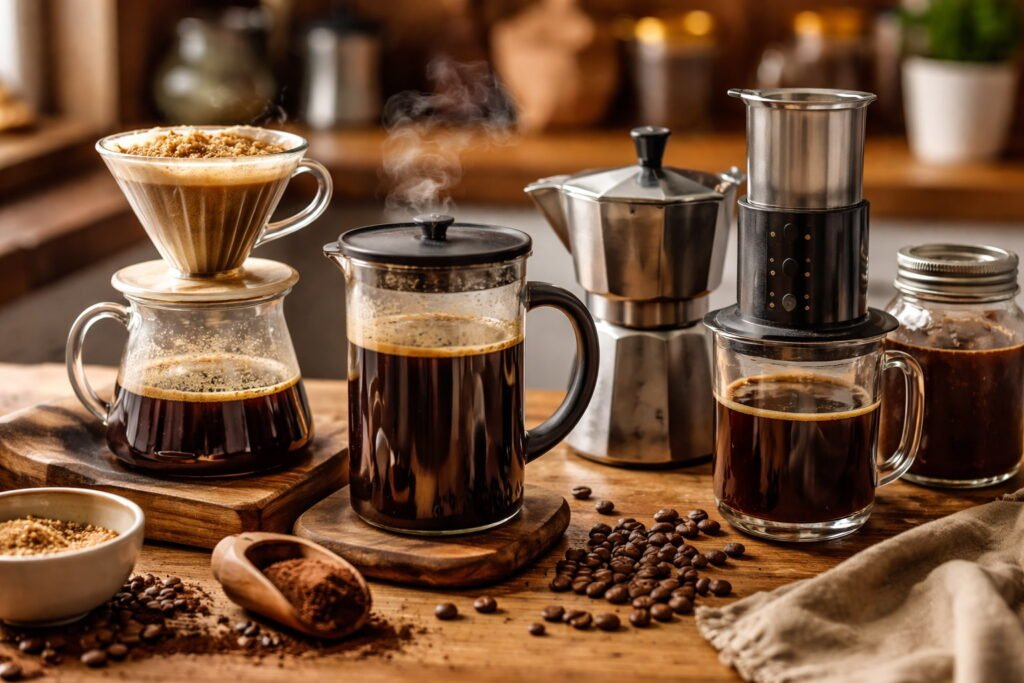
Before diving into step-by-step methods, it helps to see the big picture. Not every brewing style produces the same kind of strength—some deliver bold body, others high caffeine, and a few come close to espresso-like intensity.
Best Methods for Strong Coffee at Home
| Method | Strength Level | Flavor Profile | Ease of Use |
| French Press | High | Rich, heavy, full | Easy |
| Pour-Over | Medium–High | Clean, adjustable | Moderate |
| Moka Pot | Very High | Intense, espresso-like | Moderate |
| AeroPress | High | Smooth, customizable | Easy |
| Cold Brew | High (concentrate) | Smooth, low acidity | Easy |
How to Choose the Right Method
- Want thick, bold coffee? → Go with French press
- Want espresso-style intensity? → Choose moka pot
- Want control and clarity? → Try pour-over
- Want flexibility and experimentation? → Use AeroPress
- Want strong but smooth caffeine boost? → Make cold brew concentrate
Method 1: French Press for Rich and Heavy Coffee
French press is one of the easiest ways to make strong coffee at home without an espresso machine. It naturally produces a full-bodied, intense cup thanks to immersion brewing.
Why French Press Makes Strong Coffee
- Coffee grounds stay fully immersed → maximum extraction
- Metal filter allows oils and fine particles → richer mouthfeel
- Easy to increase strength by adjusting ratio
Step-by-Step: Strong French Press Recipe
What you need:
- Coarse ground coffee
- Hot water (92–96°C)
- French press
Steps:
- Add coffee using a 1:12 ratio (e.g., 25g coffee to 300ml water)
- Pour a small amount of water to bloom (30 seconds)
- Add remaining water slowly
- Stir gently to ensure even saturation
- Let it brew for 4–5 minutes
- Press slowly and pour immediately
Pro Tips for Maximum Strength
- Use slightly more coffee (up to 1:10 ratio) for a heavier cup
- Extend brew time to 5 minutes for deeper extraction
- Avoid very fine grind—it makes the coffee muddy and bitter
Common Mistakes That Weaken French Press Coffee
- Using stale beans → flat flavor
- Grinding too coarse → under-extraction
- Pressing too quickly → uneven extraction
Result: Expect a bold, thick, almost creamy cup with strong flavor and satisfying depth.
Method 2: Pour-Over with a Strong Twist
Pour-over is often associated with light, delicate coffee—but with the right adjustments, it can produce a surprisingly strong and intense brew.
How to Make Pour-Over Coffee Stronger
- Increase coffee dose (use 1:13–1:14 ratio)
- Use a slightly finer grind than usual
- Control pouring to extend extraction time
Step-by-Step: Strong Pour-Over Technique
What you need:
- Medium-fine ground coffee
- Filter (paper or metal)
- Dripper (V60 or similar)
Steps:
- Add coffee (e.g., 22g for 300ml water)
- Bloom with a small amount of water for 30–45 seconds
- Pour slowly in circular motions
- Maintain steady water flow (don’t rush)
- Total brew time: 2.5–3.5 minutes
Techniques That Boost Strength
- Slow pouring increases contact time → stronger extraction
- Multiple pours help saturate grounds evenly
- Use a thicker filter for more body (or metal filter for even richer texture)
Flavor Profile: What to Expect
- Cleaner than French press
- More defined flavors (chocolate, caramel, fruit notes)
- Strong, but not भारी or भारी-bodied—instead, intense yet refined
Mistakes to Avoid
- Pouring too fast → weak coffee
- Using too coarse grind → thin body
- Not blooming → uneven extraction
Result: A strong, clean, and flavorful cup—perfect if you want intensity without heaviness.
Method 3: Moka Pot – The Closest Thing to Espresso at Home
If you’re chasing that espresso-like intensity without owning a machine, the moka pot is your best friend. It uses steam pressure to push water through coffee grounds, creating a strong, concentrated brew with bold flavor.
Why Moka Pot Coffee Tastes So Intense
- Uses pressure (not as high as espresso, but enough for concentration)
- Produces a thicker, more robust cup
- Extracts deep, roasted flavors quickly
Step-by-Step: Strong Moka Pot Coffee
What you need:
- Medium-fine ground coffee (slightly coarser than espresso)
- Moka pot
- Hot water
Steps:
- Fill the bottom chamber with hot water (just below the valve)
- Add coffee to the filter basket (don’t tamp—just level it)
- Assemble the moka pot and place on medium heat
- Keep the lid open and watch the extraction
- Remove from heat as soon as coffee starts flowing rapidly or sputtering
- Stir before serving for balanced flavor
Pro Tips for Strong but Smooth Results
- Use a 1:7 to 1:9 ratio for a concentrated brew
- Start with hot water to avoid over-extraction
- Use medium heat—too high burns the coffee
Avoid These Common Mistakes
- Tamping the coffee → blocks flow and causes bitterness
- Letting it over-extract → harsh, burnt taste
- Using too fine grind → overly bitter result
Result: Expect a bold, punchy, espresso-style coffee—perfect for straight shots or strong milk drinks.
Method 4: AeroPress for Custom Strong Coffee Recipes
The AeroPress is one of the most versatile tools for making strong coffee at home without an espresso machine. It allows you to control pressure, time, and ratio—all key to dialing in strength.
Why AeroPress Is Ideal for Strong Coffee
- Uses manual pressure → enhances extraction
- Highly adjustable → you control strength precisely
- Fast brewing → strong coffee in under 2 minutes
Standard vs Inverted Method
- Standard method: cleaner, slightly lighter body
- Inverted method: longer immersion → stronger and fuller flavor
For maximum strength, go with the inverted method.
Step-by-Step: Strong AeroPress Recipe (Inverted)
What you need:
- Fine to medium-fine coffee
- AeroPress
- Hot water
Steps:
- Insert plunger and flip AeroPress upside down
- Add coffee using a 1:4 to 1:6 ratio (very concentrated)
- Pour hot water and stir thoroughly
- Brew for 60–90 seconds
- Attach filter cap, flip, and press slowly
- Dilute slightly if needed—or drink as is for maximum strength
Pro Tips to Maximize Strength
- Use more coffee, less water for a concentrate-style brew
- Press slowly for better extraction
- Experiment with brew time to fine-tune intensity
Flavor Profile
- Smooth and rich
- Less bitter than moka pot
- Strong but balanced and clean
Result: A powerful, customizable cup that can rival espresso in strength—without the harshness.
Method 5: Cold Brew Concentrate for Smooth Strength
Cold brew might not taste aggressive, but it can be one of the strongest coffee methods in terms of caffeine and concentration—especially when brewed as a concentrate.
Why Cold Brew Can Be Extremely Strong
- Long extraction time (12–24 hours) pulls out caffeine effectively
- High coffee-to-water ratio creates a concentrate
- Naturally low acidity → smooth even at high strength
Strong Cold Brew Concentrate Recipe
What you need:
- Coarse ground coffee
- Cold or room temperature water
- Jar or pitcher
Steps:
- Combine coffee and water using a 1:4 ratio
- Stir gently to saturate all grounds
- Cover and steep for 12–18 hours
- Strain using a fine filter or cloth
- Store in the fridge
How to Drink It Strong
- Drink it straight (undiluted) for maximum intensity
- Add a small amount of water or milk if needed
- Serve over ice without watering it down too much
Flavor Profile: What Makes It Unique
- Smooth, chocolatey, low bitterness
- Less acidic than hot coffee
- Strong in caffeine, but easy to drink
Common Mistakes to Avoid
- Using too much water → weak concentrate
- Not filtering properly → muddy texture
- Brewing too short → underdeveloped flavor
Result: A smooth yet powerful coffee concentrate—perfect if you want strength without harshness.
Coffee-to-Water Ratios That Actually Make Coffee Strong
If there’s one variable that instantly changes your coffee strength, it’s the brew ratio. Get this right, and you can turn almost any method into a bold, satisfying cup.
Standard vs Strong Ratios (Quick Reference)
| Brew Strength | Ratio (Coffee : Water) | Result |
| Standard | 1:15 – 1:18 | Balanced, everyday coffee |
| Strong | 1:12 – 1:14 | Noticeably bold flavor |
| Very Strong | 1:8 – 1:10 | Intense, heavy, concentrated |
| Concentrate | 1:3 – 1:6 | Espresso-style or cold brew concentrate |
Recommended Ratios by Method
- French Press: 1:10 – 1:12
- Pour-Over: 1:13 – 1:14
- Moka Pot: 1:7 – 1:9
- AeroPress: 1:4 – 1:6
- Cold Brew: 1:4 (concentrate)
How to Adjust Without Ruining Flavor
- Increase coffee dose gradually (don’t jump too far)
- Pair stronger ratios with slightly finer grind
- Extend brew time carefully to avoid bitterness
Pro Tips to Make Your Coffee Stronger (Without Ruining Flavor)
Making strong coffee at home without an espresso machine is about pushing extraction just enough—not overdoing it.
Use a Finer Grind (But Stay Method-Appropriate)
A finer grind increases surface area, helping extract more flavor.
- French press → medium-coarse (not fine)
- Pour-over → medium-fine
- AeroPress → fine to medium-fine
Extend Brew Time Carefully
A few extra seconds can deepen strength.
- Add 30–60 seconds to immersion methods
- Slow down pouring for pour-over
Avoid going too far—over-extraction leads to bitterness, not strength.
Try “Double Brewing” (With Caution)
Brewing coffee using already brewed coffee instead of water can intensify flavor—but:
- Works best with mild beans
- Can easily become overly bitter
Use sparingly and experiment.
Control Water Temperature
- Ideal range: 92–96°C
- Too hot → harsh extraction
- Too cool → weak, under-extracted coffee
Preheat Everything
Warm your brewer, mug, and filter.
Why it matters: Stable temperature = better extraction = stronger flavor.
Common Mistakes That Make Your Coffee Weak
Even with the right method, small mistakes can ruin strength.
Using Stale Coffee Beans
Old beans lose oils and aroma, resulting in flat coffee.
Fix: Buy fresh and store properly.
Wrong Grind Size
- Too coarse → under-extraction (weak coffee)
- Too fine → over-extraction (bitter, unpleasant)
Poor Ratios
Adding more water than needed dilutes everything.
Fix: Measure your coffee—don’t guess.
Rushing the Brew
Cutting brew time short leads to thin, sour coffee.
Weak Equipment Setup
- Low-quality filters that trap too much flavor
- Uneven pouring technique
- Inconsistent heat
Key takeaway: Strong coffee is the result of small details done right.
How to Customize Strength Based on Your Taste
Not everyone defines “strong” the same way. Some prefer a bold, bitter punch, while others want intensity without harshness.
Strong but Smooth vs Strong and Bold
- Smooth strength: Cold brew, AeroPress
- Bold strength: Moka pot, French press
Adjusting Flavor Balance
- Want less bitterness? → Use medium roast, lower temp
- Want more body? → Use immersion methods (French press)
- Want more clarity? → Use pour-over
Adding Milk Without Losing Strength
Strong coffee works best with milk when:
- Brewed as a concentrate (moka pot, AeroPress)
- Ratio is increased before adding milk
Find Your Personal Sweet Spot
Experiment with:
- Ratios
- Brew time
- Bean type
Tip: Keep notes—small tweaks make a big difference over time.
FAQ: Making Strong Coffee at Home Without an Espresso Machine
Can I make strong coffee without adding more coffee grounds?
Yes. Adjust grind size, brew time, and technique to increase extraction without increasing dosage.
Which method makes the strongest coffee at home?
The moka pot and AeroPress (with concentrate recipes) produce the most intense, espresso-like strength.
Does stronger coffee mean more caffeine?
Not always. Strong flavor doesn’t guarantee higher caffeine—brew ratio and bean type matter more.
What grind size is best for strong coffee?
Use a slightly finer grind than usual, but always match it to your brewing method to avoid bitterness.
Why does my strong coffee taste bitter instead of bold?
That’s over-extraction. Reduce brew time, lower temperature, or adjust grind size.
Build Your Perfect Strong Coffee Routine
Mastering how to make strong coffee at home without an espresso machine comes down to control—over your beans, ratios, grind, and brewing method.
Start simple:
- Pick one method (French press or AeroPress is ideal)
- Use a stronger ratio
- Adjust one variable at a time
Over time, you’ll develop a routine that delivers consistently bold, satisfying coffee—no expensive machine required.
For deeper brewing standards and coffee science, explore the Specialty Coffee Association’s guidelines:
https://sca.coffee/research
Now it’s your turn—grab your favorite beans, try one method from this guide, and start dialing in your perfect strong cup today.

Meet Suzee Amelia, the creative voice behind this space—a blog dedicated to exploring coffee culture, lifestyle insights, and everyday inspiration. With a passion for discovering rich flavors and sharing practical tips, Sophie Langford brings a thoughtful and engaging approach to every post.
