
A cheap home coffee brewing setup can deliver surprisingly rich, café-quality coffee—without draining your wallet. You don’t need expensive machines or fancy gadgets to enjoy a balanced, flavorful cup at home.
This guide breaks down exactly how to build a budget-friendly setup that actually works. You’ll learn which gear matters, what you can skip, and how to brew better coffee using simple tools—all based on real-world coffee experience, not hype.
In This Article
Why a Cheap Home Coffee Brewing Setup Is Smarter Than Daily Café Runs
Buying coffee every day adds up fast. A single cup might feel affordable, but the long-term cost tells a different story.
The real cost of daily coffee habits
A typical café coffee costs around $2–$5 depending on where you live. That means:
- $60–$150 per month
- $700–$1,800 per year
Compare that to a one-time setup at home, and the savings become obvious within weeks.
More control, better coffee
Brewing at home gives you full control over:
- Strength and flavor balance
- Bean freshness
- Brewing method and consistency
Even with a cheap home coffee brewing setup, you can fine-tune your cup to match your taste—something most cafés won’t customize beyond sugar and milk.
Convenience that actually fits your routine
No waiting in line, no rushed mornings. A simple setup lets you:
- Brew coffee in under 5 minutes
- Adjust your routine easily
- Enjoy fresh coffee anytime
What “Cheap” Really Means in Coffee Brewing (And What Not to Sacrifice)
“Cheap” doesn’t mean low quality—it means spending smart where it matters most.
Budget ranges that make sense
Here’s a realistic breakdown for a cheap home coffee brewing setup:
| Budget Level | What You Get | Who It’s For |
| Ultra-budget ($10–$25) | Basic brewer + pre-ground coffee | Total beginners |
| Budget ($30–$70) | Brewer + manual grinder + better beans | Best value for most people |
| Entry-level enthusiast ($80–$120) | Improved grinder + accessories | Better consistency seekers |
Where you can save money
Some items don’t need to be premium:
- Brewers (pour-over, French press) → simple design works fine
- Kettle → a standard kitchen kettle is enough
- Scale (optional) → useful, but not mandatory at first
Where you should NOT cut corners
This is where most beginners go wrong:
- Coffee beans → stale beans = flat, bitter coffee
- Grind consistency → uneven grind ruins extraction
- Water quality → bad water = bad coffee, no matter the gear
Important insight: A cheap grinder + fresh beans beats an expensive machine with stale coffee every time.
Essential Gear for a Cheap Home Coffee Brewing Setup
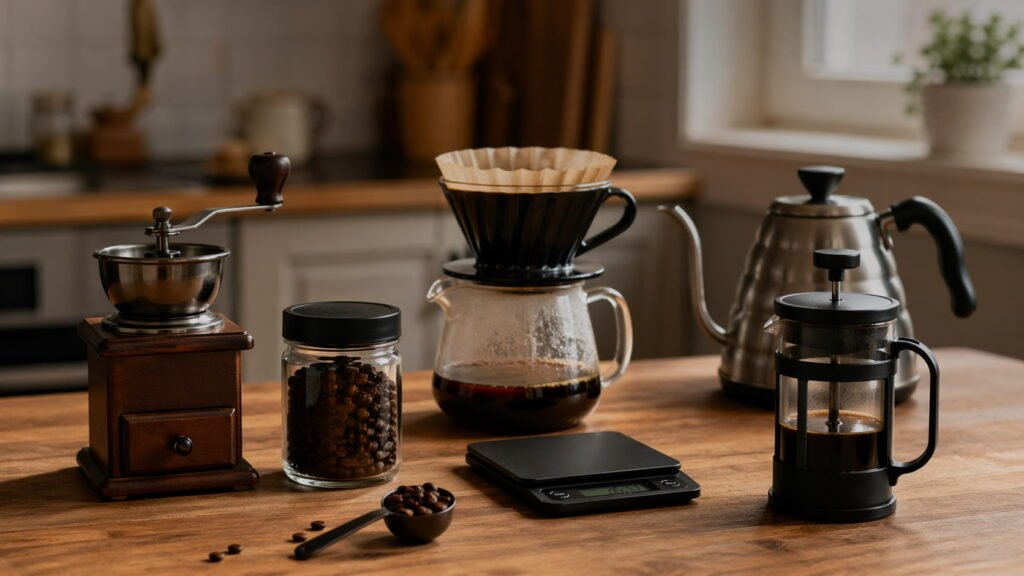
You only need a few core tools to start brewing great coffee at home. Everything else is optional.
The minimum setup (simple and effective)
At the absolute minimum:
- Manual brewer (pour-over, French press, or AeroPress)
- Coffee (whole beans or pre-ground)
- Hot water source
This setup alone can produce a solid cup if used correctly.
Choosing your brewer: simple tools that deliver great results
Each method has its own personality:
- Pour-over (clean and bright)
- Great for highlighting flavor notes
- Requires a bit more technique
- French press (bold and full-bodied)
- Easy to use
- Rich texture with more oils
- AeroPress (balanced and versatile)
- Fast and forgiving
- Can mimic espresso-style strength
Best beginner pick: French press or AeroPress for simplicity and consistency.
Manual vs. electric grinder (what actually matters)
Grinding fresh beans makes a noticeable difference in taste.
- Manual grinder
- Affordable and consistent
- Ideal for budget setups
- Requires a bit of effort
- Entry-level electric grinder
- Faster and more convenient
- Often less consistent at very low prices
Pro tip: A good manual grinder is usually better than a cheap electric one.
Do you really need a gooseneck kettle?
Not necessarily.
- A standard kettle works perfectly fine for:
- French press
- AeroPress
- A gooseneck kettle helps with:
- Controlled pouring (useful for pour-over)
Smart approach: Start with what you already have, upgrade later if needed.
Best Budget Brewing Methods Compared (Flavor vs. Cost vs. Effort)
Choosing the right method is the foundation of a cheap home coffee brewing setup. Each option offers a different balance of flavor, cost, and ease.
Quick comparison: which method fits you best?
| Brewing Method | Flavor Profile | Cost | Ease of Use | Cleanup | Best For |
| Pour-over | Clean, bright, nuanced | Low | Medium | Easy | Flavor clarity lovers |
| French press | Bold, full-bodied, rich | Low | Very easy | Moderate | Strong coffee fans |
| AeroPress | Balanced, smooth, versatile | Low–Medium | Easy | Very easy | Beginners & travelers |
| Drip machine | Mild, consistent | Medium | Very easy | Easy | Convenience seekers |
What each method really feels like in daily use
Pour-over delivers the most refined flavors, especially with lighter roasts. Expect notes like citrus, floral, or tea-like clarity. It does require attention—pouring technique matters.
French press is almost impossible to mess up. It produces a heavier cup with more oils and texture. Perfect if you enjoy a stronger, more traditional coffee taste.
AeroPress sits right in the middle. It’s forgiving, fast (2–3 minutes), and surprisingly flexible. You can brew anything from smooth black coffee to a stronger, espresso-style cup.
Drip machines are convenient, but cheap models often lack temperature control, which can flatten flavor.
Best value pick for most people
If you want the best balance of price, ease, and flavor, go with:
- AeroPress → most versatile
- French press → easiest to start
Building Your Cheap Home Coffee Brewing Setup Step-by-Step
Setting up your coffee corner doesn’t have to be complicated. A smart approach keeps costs low while maximizing quality.
Step 1: Choose your brewing method
Start with one:
- French press for simplicity
- AeroPress for flexibility
- Pour-over if you enjoy a hands-on process
Avoid buying multiple brewers at once. Master one first.
Step 2: Pick a grinder that fits your budget
If possible, go for whole beans and grind fresh.
- Entry-level manual grinder → best value
- Pre-ground coffee → acceptable for beginners
Grind size basics:
- Coarse → French press
- Medium → drip / pour-over
- Fine → AeroPress (varies by recipe)
Step 3: Choose affordable but quality coffee beans
Focus on:
- Freshness (check roast date if possible)
- Origin or blend you enjoy
- Medium roast as a safe starting point
Even budget beans can taste great when brewed correctly.
Step 4: Set up your brewing space
Keep it simple and functional:
- A small tray or corner in your kitchen
- Easy access to water and cups
- Store beans in an airtight container away from heat
Consistency improves when your setup is organized.
Example setups at different budgets
Ultra-budget setup (~$15–$25)
- French press
- Pre-ground coffee
- Regular kettle
Balanced budget setup (~$40–$70)
- AeroPress or pour-over
- Manual grinder
- Fresh whole beans
“Feels premium” budget (~$80–$120)
- AeroPress or pour-over
- Better manual grinder
- Scale (optional) + improved beans
Important insight: Spending a little more on a grinder often improves taste more than upgrading your brewer.
Cheap Coffee Beans That Still Taste Great
Great coffee doesn’t have to be expensive. The key is knowing what to look for.
What makes budget coffee taste good
Even cheaper beans can shine if they meet these criteria:
- Recently roasted (ideally within 2–4 weeks)
- Stored properly (no exposure to air or moisture)
- Roast level matched to your taste
Flavor expectations at different price points
- Lower-cost beans → chocolatey, nutty, simple flavors
- Mid-range beans → more sweetness and balance
- Higher-end beans → complex notes (fruit, floral, acidity)
There’s nothing wrong with simple flavors—many people actually prefer them daily.
Local roasters vs. supermarket coffee
Local roasters
- Fresher beans
- Better flavor clarity
- Slightly higher cost, but often worth it
Supermarket coffee
- Cheaper and widely available
- Less fresh (often no roast date)
- Works fine for beginners
Smart move: Try small bags from local roasters first—you might find affordable options that outperform big brands.
Whole beans vs. pre-ground coffee
Whole beans
- Better flavor and aroma
- Longer freshness
- Requires grinder
Pre-ground
- More convenient
- Loses flavor quickly
- Works if consumed fast
Best approach: Use whole beans if you can, but don’t let the lack of a grinder stop you from starting.
Pro tip: stretch your coffee without ruining taste
- Use the right ratio: 1:15 to 1:17 (coffee to water)
- Avoid over-extraction (too fine grind or too long brew)
- Store beans in airtight containers
Small adjustments like these can make cheap beans taste noticeably better.
How to Brew Better Coffee Without Spending More Money
A cheap home coffee brewing setup can produce excellent coffee if you focus on technique. Small adjustments often make a bigger difference than upgrading equipment.
Dial in your coffee-to-water ratio
This is the fastest way to improve taste.
- Standard range: 1:15 to 1:17 (coffee to water)
- Stronger cup → use less water
- Lighter cup → use more water
Example: 15g coffee + 240ml water = balanced, everyday brew
Match grind size to your brewing method
Grind size controls extraction. Get this wrong, and even good beans taste off.
- Coarse → French press (prevents over-extraction)
- Medium → Pour-over (balanced flow and flavor)
- Fine → AeroPress (faster extraction, stronger taste)
Warning signs:
- Bitter, harsh → grind too fine
- Sour, weak → grind too coarse
Use better water (it matters more than you think)
Coffee is ~98% water. Poor water ruins flavor.
- Use filtered or bottled water if tap water tastes off
- Avoid distilled water (flat taste)
- Ideal temperature: 90–96°C (just off boiling)
Quick hack: Let boiling water sit for 30–45 seconds before pouring.
Master simple brewing techniques
Even basic methods benefit from small upgrades:
- Bloom your coffee (pour-over & AeroPress)
- Add a small amount of water first
- Wait 30–45 seconds
- Helps release trapped gas and improves extraction
- Stir or swirl gently
- Ensures even saturation
- Keep brew time consistent
- French press: ~4 minutes
- AeroPress: ~2 minutes
- Pour-over: 2–3 minutes
Avoid these common beginner mistakes
- Using stale coffee
- Eyeballing measurements inconsistently
- Rushing the brew process
- Ignoring grind size adjustments
Bottom line: Skill and consistency will improve your coffee more than expensive gear ever will.
Cheap Upgrades That Make a Huge Difference Later
Once your basics are solid, a few low-cost upgrades can noticeably improve your results without blowing your budget.
Upgrade your grinder first (biggest impact)
If you started with pre-ground coffee or a basic grinder, this is your next step.
- Better grind consistency = better extraction
- More control over flavor
Why it matters: An upgraded grinder can make the same beans taste cleaner, sweeter, and more balanced.
Improve your filters and small accessories
Tiny changes can refine your cup:
- Higher-quality paper filters → cleaner taste
- Reusable metal filters → fuller body
- Basic scale → consistent ratios
A scale might seem unnecessary, but it eliminates guesswork completely.
Consider a gooseneck kettle (for pour-over users)
This upgrade improves pouring control:
- More even extraction
- Better flavor clarity
Not essential—but helpful if you enjoy pour-over and want more precision.
Upgrade your beans before anything else
Better beans = instant improvement.
- Look for freshly roasted options
- Experiment with origins and roast levels
Smart strategy: Upgrade one variable at a time so you can actually taste the difference.
Common Mistakes When Building a Cheap Home Coffee Brewing Setup
Many beginners waste money or get poor results—not because of budget limits, but due to avoidable mistakes.
Buying too much equipment too early
It’s tempting to build a “perfect” setup right away.
- Multiple brewers
- Extra accessories
- Tools you don’t fully understand
Reality: You only need one method to start. More gear doesn’t equal better coffee.
Ignoring grind size and freshness
Two of the most critical factors are often overlooked:
- Pre-ground coffee loses flavor quickly
- Wrong grind size ruins extraction
Even a cheap home coffee brewing setup performs well when these are dialed in.
Choosing the wrong brewing method for your lifestyle
Some methods look appealing but don’t fit daily routines.
- Pour-over requires attention and time
- French press is easier but less clean
- AeroPress is fast but more hands-on
Tip: Choose based on your mornings—not aesthetics.
Falling for “cheap but low-quality” tools
Ultra-cheap equipment can backfire:
- Inconsistent grinders
- Poorly designed brewers
- Flimsy materials
Better approach: Buy fewer items, but choose ones that are reliable.
Expecting café results instantly
Good coffee takes a bit of practice.
- Dialing in grind size
- Adjusting ratios
- Learning your method
Key mindset: Treat it as a skill, not just a purchase.
Sample Budget Setups (Realistic & Practical)
Seeing real combinations makes it easier to build your own cheap home coffee brewing setup without overthinking it.
Ultra-budget setup (simple and functional)
Perfect if you just want to get started immediately.
- French press
- Pre-ground coffee
- Regular kettle
What to expect:
- Bold, strong coffee
- Minimal learning curve
- Lower flavor clarity compared to fresh-ground
Best for: total beginners or tight budgets
Balanced budget setup (best value for most people)
This is where quality noticeably improves.
- AeroPress or pour-over brewer
- Manual burr grinder
- Fresh whole beans
What to expect:
- Cleaner, more balanced flavors
- Better aroma and freshness
- More control over strength
Best for: anyone serious about improving coffee without overspending
“Feels premium” setup (without premium price)
A step up in consistency and enjoyment.
- Pour-over or AeroPress
- High-quality manual grinder
- Digital scale (optional)
- Fresh specialty beans
What to expect:
- Consistent, repeatable results
- More refined flavor notes
- Better brewing precision
Best for: coffee lovers who want café-like quality at home
Cheap Home Coffee Brewing Setup vs. Expensive Setup: Is It Worth Upgrading?
Expensive coffee gear looks appealing, but the difference isn’t always as dramatic as you might expect.
What actually changes with expensive gear
Higher-end setups typically offer:
- Better temperature stability
- More consistent grind size
- Greater control over variables
These improvements matter—but mostly for enthusiasts chasing precision.
Real-world taste difference
For most people:
- A well-used cheap home coffee brewing setup can produce 80–90% of the quality
- The remaining difference is subtle and requires experience to notice
Important insight: Technique and fresh beans matter far more than price.
Who should consider upgrading
Upgrading makes sense if:
- You’ve mastered your current setup
- You can consistently taste differences
- You want more control and repeatability
If not, your current setup is likely already “good enough.”
Quick Brewing Routine for Busy Mornings (Using a Budget Setup)
A cheap setup doesn’t have to slow you down. With a simple routine, you can brew great coffee in minutes.
Fast and effective workflow (under 5 minutes)
- Heat water
- Grind coffee (or use pre-ground)
- Add coffee to brewer
- Pour water (bloom if possible)
- Brew and serve
Time-saving tips that actually work
- Pre-measure coffee the night before
- Use a consistent scoop if you don’t have a scale
- Stick to one brewing method to build muscle memory
Consistency is your secret weapon
Repeating the same process daily:
- Reduces mistakes
- Improves flavor over time
- Makes adjustments easier
Result: Better coffee with less effort.
FAQ: Cheap Home Coffee Brewing Setup
What is the cheapest way to start brewing coffee at home?
Use a French press with pre-ground coffee and a regular kettle. It’s simple, affordable, and delivers strong, reliable results.
Do I really need a grinder for good coffee?
A grinder isn’t mandatory, but it significantly improves freshness and flavor. Whole beans retain aroma much longer than pre-ground coffee.
What grind size should I use for different brewing methods?
Coarse for French press, medium for pour-over, and fine to medium-fine for AeroPress. Adjust slightly based on taste (bitter = too fine, sour = too coarse).
How long should I brew my coffee for best results?
French press: around 4 minutes. Pour-over: 2–3 minutes. AeroPress: about 2 minutes. Consistency matters more than exact timing.
How should I store coffee beans to keep them fresh?
Keep beans in an airtight container, away from light, heat, and moisture. Avoid storing them in the fridge.
Can cheap coffee beans still taste good?
Yes—when brewed properly. Focus on freshness, correct grind size, and proper ratios to get the best flavor from budget beans.
Learn More About Coffee Standards and Brewing Science
If you want to go deeper into coffee quality and brewing standards, check out the Specialty Coffee Association’s guidelines:
👉 https://sca.coffee/research
This resource explains how variables like extraction, water quality, and grind size impact your cup.
Great Coffee Starts With Smart Choices, Not Expensive Gear
A cheap home coffee brewing setup is more than enough to make delicious coffee every day. What matters most is how you use it.
Start simple. Focus on fresh beans, proper ratios, and consistent technique. Upgrade slowly as your taste develops.
Your next step: pick one brewing method, build your setup, and start experimenting. The best cup of coffee isn’t the most expensive one—it’s the one you dial in yourself.

Meet Suzee Amelia, the creative voice behind this space—a blog dedicated to exploring coffee culture, lifestyle insights, and everyday inspiration. With a passion for discovering rich flavors and sharing practical tips, Sophie Langford brings a thoughtful and engaging approach to every post.
