

If you rely on convenient coffee add-ins, understanding coffee-mate creamer singles nutrition facts can make a bigger difference than you think. Those tiny tubs may seem harmless, but their ingredients and calorie impact can add up quickly—especially if you drink multiple cups a day.
This guide breaks down exactly what’s inside Coffee-Mate singles, how they affect your daily nutrition, and how they compare to other creamer options. You’ll walk away knowing whether they fit your routine—and how to use them smarter.
In This Article
What Are Coffee-Mate Creamer Singles? (Quick Overview)
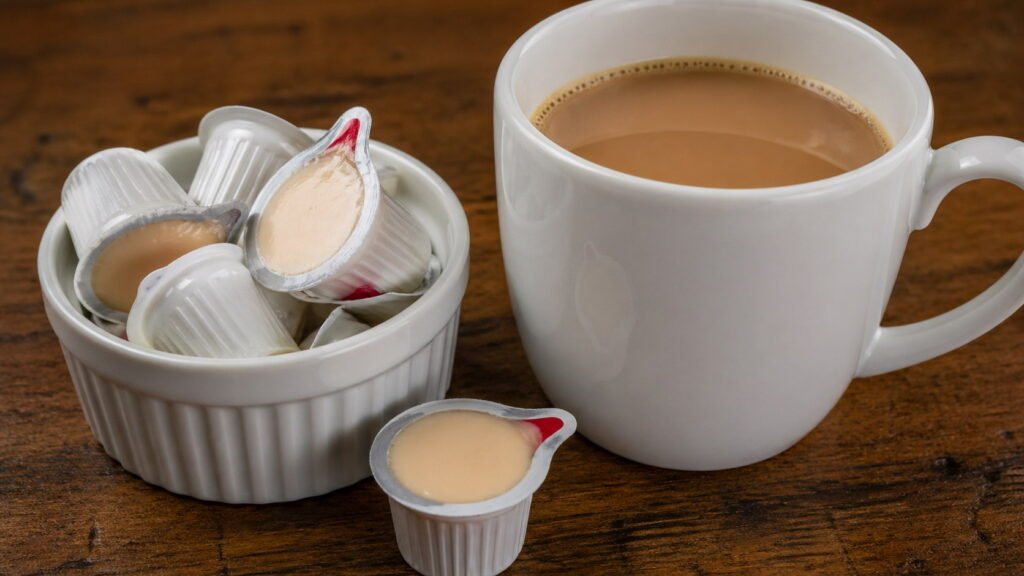
Coffee-Mate creamer singles are single-serve portions of non-dairy creamer, typically packaged in small plastic tubs or pods. They’re designed for convenience—no refrigeration required and easy to grab on the go.
Why people use them
- Perfect for offices, hotels, and travel
- Long shelf life compared to fresh milk or cream
- Pre-measured portions for consistent taste
How they compare to traditional creamers
Unlike fresh milk or half-and-half, these singles are shelf-stable, meaning they don’t spoil quickly. That’s possible because they’re made with processed ingredients instead of fresh dairy.
From a coffee experience standpoint, they offer a consistent creamy texture, but often lack the natural richness and subtle sweetness you get from real milk.
Coffee-Mate Creamer Singles Nutrition Facts Explained
Understanding the label is key if you’re trying to manage calories, sugar, or fat intake.
Standard nutrition per single serving (approx. 11 ml tub)
- Calories: 10–15
- Total fat: 1–1.5g
- Saturated fat: 0.5–1g
- Carbohydrates: 1–2g
- Sugars: 1g
- Sodium: 5–10mg
These numbers can vary slightly depending on flavor, but they give a solid baseline.
What stands out nutritionally
Low calories per serving—but easy to overuse
One creamer seems insignificant. Three or four cups of coffee a day? That’s where it adds up.
Hidden sugars in small doses
Even 1 gram of sugar per serving becomes noticeable if you’re adding multiple creamers daily.
Fat content comes from processed oils
Instead of natural milk fat, these creamers rely on vegetable oils, which behave differently in your body.
Quick comparison to dairy creamer
| Type | Calories (per tbsp) | Fat | Sugar |
| Coffee-Mate Single | 10–15 | 1g | 1g |
| Whole Milk | ~9 | 0.5g | 1g |
| Half-and-Half | ~20 | 1.7g | 0g |
Key takeaway: Coffee-Mate singles aren’t drastically higher in calories, but their ingredient quality differs significantly.
Ingredient Breakdown: What’s Really Inside Coffee-Mate Singles?
The ingredient list reveals more than the nutrition label alone. Coffee-Mate singles are classified as non-dairy creamers, but that doesn’t necessarily mean they’re free from milk-related components.
Core ingredients explained
- Corn syrup solids
A processed sweetener that provides both sweetness and body. - Hydrogenated vegetable oils (coconut or palm)
These create the creamy texture but are highly processed. - Sodium caseinate
A milk-derived protein used for texture—this is why “non-dairy” doesn’t mean dairy-free. - Emulsifiers and stabilizers (like mono- and diglycerides)
Help keep the mixture smooth and prevent separation in your coffee.
Are they really non-dairy?
Technically labeled as non-dairy, but not suitable for strict dairy-free diets due to sodium caseinate.
For people with lactose intolerance, they’re usually tolerated well since they contain minimal lactose.
What this means for your coffee
These ingredients are engineered to deliver:
- A consistent creamy mouthfeel
- Mild sweetness without needing sugar
- Stability in hot coffee without curdling
However, the trade-off is heavy processing, which matters if you’re trying to keep your diet clean or minimally processed.
How Coffee-Mate Creamer Singles Affect Your Daily Nutrition
Those small portions can quietly shape your daily intake—especially if coffee is part of your routine.
Calories add up faster than you expect
A single tub is only about 10–15 calories, but drinking multiple cups changes the picture:
- 1 cup (1 creamer): ~15 calories
- 3 cups (3 creamers): ~45 calories
- 5 cups (5 creamers): ~75+ calories
Key takeaway: It’s not the single serving—it’s the repetition.
Sugar intake in small increments
Each serving typically contains around 1 gram of sugar. That seems minimal, but over time:
- 4 cups daily = 4g sugar
- 30 days = 120g sugar from creamer alone
That’s enough to matter if you’re watching blood sugar or reducing added sugars.
Sodium and fat considerations
Sodium levels are low per serving, but still contribute to your daily total. The bigger concern is fat source quality:
- Comes from processed vegetable oils, not natural dairy
- May include partially hydrogenated oils in some versions
Who should be more cautious
- People managing weight loss or calorie tracking
- Those on low-sugar or diabetic-friendly diets
- Anyone aiming to reduce processed foods
Used occasionally, they’re convenient. Used heavily, they can quietly shift your nutrition in the wrong direction.
Coffee-Mate Creamer Singles Nutrition Facts vs Liquid Creamers
Not all creamers are created equal. Comparing singles to liquid options helps put their nutrition into perspective.
Side-by-side comparison
| Feature | Coffee-Mate Singles | Liquid Coffee-Mate | Half-and-Half |
| Calories (per serving) | 10–15 | 35–50 | ~20 |
| Sugar | ~1g | 5–8g | 0g |
| Fat source | Vegetable oils | Oils + dairy mix | Natural dairy |
| Shelf life | Long (no fridge) | Refrigerated | Refrigerated |
What makes singles different?
Lower calories per serving
Because they’re smaller and more diluted, singles seem lighter—but that can be misleading if you use multiple.
Less sugar than flavored liquid creamers
Liquid creamers often pack significantly more sugar, especially flavored ones.
More processed overall
Singles rely heavily on stabilizers and additives to stay shelf-stable.
Taste and coffee experience
- Singles produce a consistent but lighter body
- Liquid creamers feel richer and more indulgent
- Half-and-half delivers the most natural flavor enhancement
Practical tip: If you enjoy bold coffee (like a dark roast), singles may not provide enough creaminess unless you use more than one.
Are Coffee-Mate Creamer Singles Healthy or Not?
This is where nuance matters. Coffee-Mate singles aren’t inherently “bad,” but they’re not exactly a health food either.
The upsides
- Convenience is unmatched
No refrigeration, no measuring, no mess - Portion control is built-in
Each tub gives you a predictable amount - Lower calories than many flavored creamers
Helpful if you’re trying to avoid high-sugar options
The downsides
- Highly processed ingredients
Includes oils, emulsifiers, and artificial stabilizers - Limited nutritional value
No meaningful vitamins, minerals, or protein - Easy to overconsume
Multiple servings quickly cancel out the “low calorie” benefit
So, are they healthy?
In moderation, yes. As a daily habit in large amounts, not ideal.
If your goal is convenience and consistency, they work. If your goal is cleaner nutrition or better-quality ingredients, there are stronger options.
Flavored vs Original: Do Nutrition Facts Change?
Flavored Coffee-Mate singles—like vanilla or hazelnut—seem similar to the original at a glance, but their nutrition profile can shift in subtle ways.
What changes with flavored versions
- Slightly higher sugar content
Flavorings often add extra sweeteners, even if it’s just a fraction more per serving. - Calories may increase slightly
Still low overall, but flavored options can land closer to 15–20 calories per tub. - Added artificial or natural flavors
These enhance taste but don’t contribute nutritional value.
Typical comparison
| Type | Calories | Sugar | Flavor Profile |
| Original | 10–15 | ~1g | Neutral, creamy |
| Vanilla | 15–20 | 1–2g | Sweet, dessert-like |
| Hazelnut | 15–20 | 1–2g | Nutty, aromatic |
Which is the “lightest” option?
Original (unflavored) is usually the safest choice if you want to minimize sugar and additives. Flavored versions are more enjoyable for many people—but easier to overuse because of their sweetness.
Practical tip: If you enjoy flavored coffee, try using one flavored creamer + one original to balance taste and reduce sugar.
Coffee-Mate Creamer Singles Nutrition Facts for Special Diets
Not every creamer fits every lifestyle. Coffee-Mate singles sit in a gray area for several popular diets.
Keto and low-carb diets
- Each serving has ~1–2g carbs, mostly from sugar
- Not ideal for strict keto, but may fit in very small amounts
Better approach: Use sparingly or combine with heavy cream to reduce total carb impact.
Vegan considerations
- Labeled “non-dairy,” but contains sodium caseinate (milk-derived)
- Not suitable for strict vegan diets
Important distinction: Non-dairy ≠ vegan-friendly.
Lactose intolerance
- Contains minimal to no lactose
- Generally well tolerated by those with lactose sensitivity
Weight loss or calorie-controlled diets
- Low per serving, but easy to overconsume
- Works best when limited to 1–2 servings per day
Clean eating or whole-food diets
- Falls short due to processed oils and additives
- Not aligned with minimally processed food goals
Key takeaway: Coffee-Mate singles can fit some diets—but rarely as a primary or daily creamer.
How Many Coffee-Mate Singles Per Day Is Too Much?
There’s no strict limit, but there is a point where convenience starts working against your nutrition.
A practical guideline
- 1–2 singles per day: Generally reasonable
- 3–4 singles per day: Moderate—watch sugar and calories
- 5+ singles per day: Likely excessive for most people
Real-world scenarios
Light coffee drinker (1 cup/day)
- 1 creamer = minimal impact
Regular coffee drinker (3 cups/day)
- 3 creamers = noticeable calories and sugar
Heavy coffee drinker (5+ cups/day)
- 5–8 creamers = hidden calorie source
What happens when you overdo it
- Extra empty calories without nutritional benefit
- Increased added sugar intake
- Greater reliance on processed ingredients
Smarter way to think about it
Instead of counting just creamers, think in terms of your total coffee habit.
Simple rule:
If your creamer intake grows with your coffee consumption, it’s time to adjust.
Try reducing gradually:
- Use fewer creamers per cup
- Switch some cups to black coffee
- Alternate with milk or plant-based options
That way, you keep the convenience—without letting it quietly take over your daily nutrition.
Smart Ways to Use Coffee-Mate Singles Without Overdoing Calories
Convenience doesn’t have to come at the cost of your nutrition. With a few small adjustments, you can enjoy Coffee-Mate singles while keeping calories and sugar in check.
Use fewer creamers per cup
Many people default to one full tub per cup, but stronger coffee can handle less.
- Try ½ to 1 creamer per cup
- Brew slightly stronger coffee to maintain flavor balance
Tip: A bolder brew (like a medium-dark roast) naturally tastes richer, so you won’t need as much creamer.
Combine with milk or alternatives
Stretch the flavor while improving nutrition:
- Add a splash of milk or oat milk + 1 creamer
- Use singles for flavor, milk for texture
This reduces reliance on processed ingredients while keeping that creamy taste.
Be mindful of flavored versions
Flavored singles are easy to overuse because they taste sweeter.
- Use only one flavored creamer, then switch to original
- Alternate between flavored and plain coffee
Build a better coffee base
Better coffee = less need for additives.
- Use freshly ground beans
- Stick to a balanced brew ratio (1:15 to 1:17 coffee-to-water)
- Avoid over-extraction, which creates bitterness
Key takeaway: The better your coffee tastes, the less you’ll rely on creamers to fix it.
Better Alternatives to Coffee-Mate Creamer Singles
If you’re aiming for cleaner ingredients or better nutrition, there are several solid alternatives worth trying.
Natural dairy options
- Whole milk: Balanced and naturally sweet
- Half-and-half: Richer texture, no added sugar
- Heavy cream: Very low carb, great for keto (in moderation)
Plant-based creamers
- Oat milk: Smooth and slightly sweet
- Almond milk: Light and low calorie
- Coconut milk: Rich with a subtle tropical note
Look for versions labeled unsweetened to avoid hidden sugars.
Low-sugar and sugar-free creamers
- Available from many brands
- Often use alternative sweeteners instead of sugar
Caution: Some may contain artificial ingredients, so check labels carefully.
Simple homemade creamer idea
Blend:
- 1 cup milk (or plant-based milk)
- 1–2 teaspoons maple syrup or honey
- A splash of vanilla extract
Shake and store in the fridge for a cleaner, customizable option.
Storage, Shelf Life, and Freshness Tips
One of the biggest advantages of Coffee-Mate singles is their long shelf life—but proper storage still matters.
Why they last so long
- Made with shelf-stable ingredients
- Packaged in airtight containers
- No need for refrigeration until opened
How to store them properly
- Keep in a cool, dry place
- Avoid direct sunlight or heat exposure
- Store unopened packs at room temperature
How to tell if a creamer has gone bad
Even shelf-stable products can degrade over time.
Watch for:
- Swollen or leaking containers
- Unusual smell when opened
- Separation or curdling in coffee
When in doubt, toss it. The cost of a single creamer isn’t worth ruining your cup.
Frequently Asked Questions About Coffee-Mate Creamer Singles Nutrition Facts
Do Coffee-Mate creamer singles contain dairy?
They are labeled non-dairy, but contain sodium caseinate, a milk-derived protein, so they are not completely dairy-free.
Are Coffee-Mate singles safe for daily use?
Yes in moderation. Using 1–2 per day is generally fine, but higher amounts can increase sugar and processed ingredient intake.
Do Coffee-Mate singles spike blood sugar?
They can contribute to small spikes due to added sugars, especially if used multiple times throughout the day.
Are there sugar-free Coffee-Mate singles?
Yes, some versions use alternative sweeteners instead of sugar, but ingredient quality varies.
How do Coffee-Mate singles compare to powdered creamers?
They’re similar in ingredients, but singles offer better portion control and often mix more smoothly in coffee.
Final Thoughts: Should You Use Coffee-Mate Creamer Singles Daily?
Coffee-Mate creamer singles deliver exactly what they promise—convenience, consistency, and ease of use. For busy mornings, travel, or office setups, they’re hard to beat.
Still, the nutrition trade-offs are real. Processed ingredients, small amounts of added sugar, and the tendency to overuse them can quietly impact your daily diet.
If you enjoy them, keep it intentional:
- Use 1–2 per day when possible
- Focus on better-quality coffee to reduce reliance
- Rotate in milk or plant-based alternatives for balance
For deeper guidance on coffee quality and preparation standards, the Specialty Coffee Association offers excellent resources: https://sca.coffee
Your coffee routine should work for you—not against your goals. Experiment with small changes, pay attention to taste and nutrition, and build a setup that actually fits your lifestyle.

Meet Suzee Amelia, the creative voice behind this space—a blog dedicated to exploring coffee culture, lifestyle insights, and everyday inspiration. With a passion for discovering rich flavors and sharing practical tips, Sophie Langford brings a thoughtful and engaging approach to every post.
